"What book were you reading?"
Raise your hand if you've thought that when reading a review that you disagreed with. That sense of confusion is the subject of this week's post. I've wondered how two people can read the same book and have opposite opinions of the same thing. Not subjective things like 'thrilling' or 'well written' but factual details as well. I have experience with this on both ends.
1. Reading
The first book I read as a book reviewer was called 'Talented'. The author marketed it as a sci-fi thriller staring a teenage psychic that works for what is, more or less, the CIA. What I read was a teen romance drama with the above as a veneer. (You can read the rest of the review here). This was part of a Goodreads group so I expected the others to concur but they didn't. Most of them said they liked the action and conspiracy plot. If they mentioned the romance it was only in positive terms. This baffled me so much I wrote a second blog post which I will not link to because it is bitter and angry. (If you want to look for it, go ahead. Maybe you can confirm or deny my theories.)
Then there was one review where I agreed with everything the reviewer said but I didn't like the book as a whole. They read my review and acknowledged that the romance bogged down the plot. It came down to 'agree to disagree'.
2. Writing
As of this writing A Mage's Power has 38 reviews ranging from one star to five star. The one thing they agree on is that it needs professional editing. (Which has been taken care of!) I will focus on two reviewers that took contrasting views on the protagonist's development. One says it follows the cliche of 'instant hero' and another says did not follow the 'normal weakling to massive power within a few chapters' progession. As the author I can safely say that Eric does not kill a monster on his own until chapter nine and his teammates kill the same breed of monster at the same time and also on their own.
I would like to discuss the first review with its writer but a blog post from Jean Gill advised me against interacting with readers who give negative reviews. (You can read it here.) So I am left to ponder alone and in silence, unless you have any ideas.
Do you?
Tuesday, March 12, 2013

Tuesday, March 5, 2013
Answering Review Request: "Ballad of the Nameless Traveler"
I was asked by Tomeki Piorkowski to review his story "Ballad of the Nameless Traveler". It takes the form of an epic poem narrating the traveler's adventures across the Eurasian Continent. It's a nice set up but the execution was horrible because of the overpowered protagonist.
There are five individual story arcs in five different regions with an overall story arc connecting them. The first arc is awful because the Traveler does everything; the only characters other than minions are a Distressed Damsel and her incompetent brothers. The second story arc is better because all he does is wrestle a golem. The conflict is resolved by others. The third arc is also great because he does nothing more than keep the enemy mage busy while the locals deal with the villain. The fourth story arc is bad for other reasons including this one; a lot of fumbling and idiocy on all sides, hero and villain both. The fifth story arc gets a paragraph to itself.
There are a number of things wrong. 1.) As usual only the Nameless Traveler gets to do anything important but this case is especially bad because he's supposed to need five companions. There's a prophecy and everything but all they can do is draw away mooks that he could easily beat on his own. In the end they are Team Cannon Fodder. 2.) The Nameless Traveler is suddenly weaker. In the previous story arcs he fought off armies single-handed and didn't need to rest for days while fighting armies single handed. Here he tires easily before the Drama Preserving Handicap, which, by the way, is the first time he has been injured. 3.) Tangents; each time one of the five has served their purpose the story goes on a long tangent that could be its own story arc but is compressed and squeezed in here. It throws off the pacing and the narrator apologizes for it. If he felt that way he shouldn't have digressed in the first place. I can only presume that he did this to provide closure for the characters without interrupting the hero's own ending, which brings me to my next point. 4.) An author can not use The Adventure Continues and The Hero Dies simultaneously. It doesn't work that way. It must be one, the other, or involve Passing the Torch. 5.) Conclusions are about wrapping things up but this one only brings up more questions. In the first four, the Nameless Traveler was a mystery; a void; now he's some kind of holy warrior on a mission from God whose doesn't use his name because that somehow keeps his true power sealed and releasing it would kill him. It sounds Messianic Archtype-y which adds to the Marty Stuness.
I have never seen a more blatant one than the Nameless Traveler. Inexplicably this guy is a martial arts expert, a master mage, has an aura of charisma that makes everyone like him instantly (unless they're stupid or evil) and is so handsome that even heterosexual guys are attracted to him. The first major villain is defeated as easily as his minions. All the other villains fare just as well so the most interesting stories are the ones where the Traveler can't fix the problem by punching someone. All this is made worse by the narrator referring to him as 'wonderful hero' and other such terms. The only way he could be worse is if he rode a mythical creature like a unicorn or a dragon instead of a horse.
Speaking of the horse, she has more personality than he does. I picture the horse as a Type A tsundere; sweet to the Traveler but cold and haughty to everyone else. The Traveler himself has no personality. There is nothing more to him than bland heroism and there is no backstory to explain the source of this heroism; there are no quirks or traits that could distinguish him. He is nothing more than a moving ball of conflict resolving power. Secondly the horse is not as overpowered as him; she does nothing that a real war horse could not reasonably do. For this reason I like the (also nameless) horse much more than I like the nameless traveler.
The third major character is Dundee, a vampire that follows the Traveler for revenge and is far more interesting than the Traveler. For one he has a name. For two he is not showered with praise by the narrator. For three he has a personality and a dynamic one; on one hand he wants to kill a hero for killing his evil father but he himself is a hero. Indeed, he has his own subplots where he delays his vengeance in order to stop by a local village and save Innocent Bystanders. For four, he is not all powerful. Like traditional vampires he is vulnerable to sunlight and his enemies take advantage of this on three occasions. As a reader, I would have preferred The Traveler to be a Decoy Protagonist and have the story follow Dundee instead.
There are other characters and they are also more interesting. In fact, the Traveler is the least interesting character in this story. They all have backstories and personalities and, of course, names. However, only once are they allowed to resolve the conflict themselves. Every other time they are quickly reduced to either begging the Traveler to save them or could not do it without him. He has all the subtly of a Deus Ex Machina because his appearance is often preceded by an appeal to the gods. Not 'God' but 'gods'; plural.
My opinion of the poem's mechanics are more mixed. On one hand, the poem gives the feeling of listening to a minstrel at court or a storyteller at a campfire. An atmosphere like that is suitable for an epic poem. On the other hand, the author is slavishly devoted to the same meter (AA, BB,) and for this purpose mangles sentence structure and uses anarchic words. This led to groaning on my part because it was painfully obvious and ruins the tension. On a third hand, the dialogue is usually good; there are badass boasts and cunning quips, etc. It is the narration that suffers.
Determining this book's rating was a unique challenge. It was a like a rollercoaster; first arc (F), second arc (A), third arc, (A), fourth arc (D), fifth arc (C). To create an overall review I had to average them all together. Between the good and the bad I was going to round up and give the author a C for having the guts to write in epic verse but then I read the final lines. I would have been fine with an Unreveal-nothing wrong with keeping the mystery-but this was the most corny and trite method possible to end the story; the wonderful, powerful, handsome, charismatic hero's name is the reader's name. It so disgusted me I thought "D!". If the Traveler had some catchphrase like 'you are the real hero' then it would have been okay but this comes out of nowhere and feels like a cop-out. I thought about it and wanted to give the book a straight up F. This author clearly knows how to write a conflict driven and engaging story without a single overpowered hero (the second and third arcs prove this) but for some reason chose not too. I wavered between F and D while writing this review and finally came to a decision.
Trickster Eric Novels gives "The Ballad of the Nameless Traveler" a D-
Click here for the next review request: Flames of Ether
Click here for the previous review request: Forever Gate part 1
Monday, March 4, 2013
Inspirational Monday: One Year of Experience
My first free promotion ended last weekend and I'm pleased with the results. Since it coincided with the first Monday of the new month I've decided to use this month's Inspirational Monday to look back on my experience since publishing A Mage's Power.
I'm no longer editorial arrogant. Last year I thought I could be my own editor. I was so sure I could find all the errors I made three passes through the manuscript after I thought it was clean. It still wasn't and in the end I hired an editor but that wasn't the arrogant crushing blow. No, that came when the editor I hired said my manuscript required more than a light proofing. I was making the same error over and over again which lead to thousands of errors. Most of my 1 star reviews and also some of the positive reviews remark that the editing (my editing) was horrible. My book's overall rating would be higher if I had swallowed my pride and hired an editor before hand. When I finish the sequel, Looming Shadow, I will order more than a light proofing and put aside a month (or +1 weeks for however long they think it will take, which ever's longer) for them to do their thing.
It's been about a year since I took social media seriously and I'm still learning how to take full advantage of it. Creating this blog was the best I've done in that regard. It gives me a center to showcase my work and from which I can expand outward. I use writing tips and book reviews to attract hits and relate the former to my books and their pages at the top of this one. This also allows me to connect with other authors, like Isaac Hooke. We have a symbiotic relationship going on with retweeting and review giving.
My most recent experience is the above mentioned free promotion. I decided to do it once I received the professional edits for A Mage's Power. The idea was to get it into as many hands as possible to wash away the preception that the book was full of errors. At midnight on Saturday KDP recorded 951 downloads; for comparison this is 3/4 of my 'paid' downloads for the entire month of February. This fulfilled my objective so I'm happy with it.
With all this experience the launch of Looming Shadow will more successful and have fewer setbacks. Most inspiring of all is how many readers have said they're waiting for it. To them I'm not an unknown author anymore.
Wednesday, February 27, 2013
Avoiding Tunnel Vision
When I was in the planning stages of "A Mage's Power" there were a number of goals I wanted to accomplish. One was of them was avoiding Tunnel Vision. By this I mean the perception that nothing happens outside of what the main characters experience. This is part of creating the "Full Picture". There are more people living on Tariatla than my protagonist and his immediate friends, and there are more locations then he personally sets foot on
I didn't want characters to disappear into a void when they walk off-screen. Radiata Stories, a video game by Square Enix, is the reason why. If you look around my blog or pay attention when reading A Mage's Power, you'll see this game's influence because it is a great game. There are no 'generic NPCs'. Every single character has their own sprite and their own schedule. After years of games where the NPCs all looked the same and stood around like statues this here was a living and vibrant world. I wanted to replicate that in my story. I created personalities and histories for characters that I knew would have small roles so they would be stronger characters despite their little screen time. When they weren't talking or working with Eric I wanted a reader to believe they could be doing something instead of vanishing into oblivion.
Part of this involves a shifting of main characters. In A Mage's Power, only Eric is in every scene. In the second chapter, he gains school friends and spends a lot of time with them when he is in school. Once he joins the Dragon's Lair he is busy with guild missions and training and so he has less time for them and so they appear less often. This is intentional. They are important to Eric but they are their own characters and do not derive their substance from their relationship with him. On TV tropes we call those kinds of characters a Satellite Character because they have no purpose other than orbiting another character, usually the protagonist.
In the fifth chapter, Eric is assigned two teammates and a mentor to make a four person team. His time spent with them comprises the bulk of the book. However, they are not in every scene either. After missions and training Eric's teammates would wander off to other friends and other activities because their lives do not revolve around Eric. This is why he does not think to invite them on a volunteer mission; he can't think of a reason why they would join him. Instead he seeks out someone who is motivated to complete the mission.
The downside to this is that I have a lot of characters and a shifting main cast. Some people find that confusing and I totally understand. If I didn't have character sheets for all of them, then I wouldn't be able to keep them all straight all the time either. However, I think this is more realistic than having a small cast of character do everything, and creating this scene of a concrete-real-world is another goal I wanted to accomplish with this book. To read more about that, click here for "Primary Abstract vs Secondary Concrete".
For similar posts about the setting instead of characters, see "A World of Monsters" and "To Build a World Think about Ants"
Brian Wilkerson is a freelance book reviewer, writing advice blogger and independent novelist. He studied at the University of Minnesota and came away with bachelor degrees in English Literature and History (Classical Mediterranean Period concentration).
Tuesday, February 19, 2013
Answering Review Request: Forever Gate 1
I read Isaac Hooke's "Forever Gate" as part of a review exchange. He's reading my "A Mage's Power" right now. That's "Social Media Reciprocity" in action.
"Forever Gate" takes place in a fantasy setting that is NOT the medieval ages. It's actually 3740 A.D. but one could be forgiven for thinking it was somewhere in the 1000s. Hoodwink, the protagonist, thinks it's semantics. He's only interested in keeping someone important to him safe and this leads him from one dangerous situation to another.
The plot is fast paced. From execution to run from the law to secret society Revelations to climbing the Forever Gate. There's no time to catch your breath because this book has relentless energy. Hoodwink is always moving and getting in and out of close calls. Each chapter is a cliffhanger and it is a meaningful cliff hanger. It's not an instant tacked on thing meant to invoke cliffhanger. Even the final chapter ends in a cliffhanger and it includes a wham line. There's a preview for the second book and that also ends in a cliffhanger.With all the cliffhangers you may be wondering: does story ever resolve anything? The answer is complicated.
Courtesy SPOILER warning
Hoodwink's goal is to keep his daughter out of harm's way. He does this by taking her place for things like climbing the sky-high Forever Gate. At the end of the book he succeeds and is at peace with himself but the root cause that got him into trouble in the first place has not been touched. This is the first book so I don't mind because the initial 'save my daughter' conflict has been resolved. On the other hand, the final chapter's cliffhanger would have infuriated me if not for the second book's preview. It's a great place to stop, don't get me wrong, but it opens up a new can of worms. In my opinion, the second book preview works better as an epilogue and sequel hook than a genuine preview because it lets the reader know the results of Hoodwink's harrowing quest (providing closure) while at the same time setting up the next book.
Hoodwink is a great protagonist. He's an anti-hero without being dark and edgy. Instead he's a loving father that doesn't care about heroics. It's a rare breed; not original but rare. Another point in his favor is that he is not a teenager. You see those a lot in fantasy and they all say 'averarge kid' who is not at all average. This is an older married guy and there really is nothing special about him but then again he's not a bland audience surrogate.
Unfortunately, other characters have much less development but this can be attributed to their little screen time. In the first scene Hoodwink is running from the law and then he climbs a wall and then he crosses a desert. In other words, he spends much of the book alone with his thoughts. It's great for him but less so for the others. Ari, for instance, receives more character development in the preview for the second book then she does in the entirety of the first book. In the later her role is summed up in Hero's Muse, but interestingly, she is aware of this and exploits it. The only reason Hoodwink climbs the Forever Gate is because if he didn't she would and both of them know this would likely kill her.
The closest thing this series has to 'bad guys' are a similar case. They're called gols and they're artificial humans that run the city. Hoodwink thinks they're 'oppressors' but Leader points out that they are closer to 'despised but necessary public servants'. The latter is the one leading a resistance group against them, which begs the question: If they are not evil then why is he fighting them? Also, if he knows they are necessary and wants them to stay in power then why do the Gol think he is a terrorist? Current events have some answers but not all of them and without these questions the premise of the novel falls apart. Hoodwink's relationship troubles with his daughter have greater depth and are therefore more interesting.
Spelling and such are great but the grammar is distracting. As many as three sentences in a row will go something like 'Hoodwink x. And then y. But z." when they could all be one sentence. This is forgivable because they are most prevalent in Hoodwink's stream of consciousness and nobody thinks in perfect grammar. That would be weird. It's still distracting.
Trickster Eric Novels gives "Forever Gate 1" an A
Click here for the next review request: Ballad of the Nameless Traveler.
Click here for the previous review request: Adventure Hunters
Tuesday, February 12, 2013
Answering Review Request: Adventure Hunters by Cody Martin
"Adventure Hunters" is a low fantasy with a trio of heroes doing their own thing but get caught up in a big plot. It's not original by any means so I like it all the more. After reading the first arc I thought of it as mashed potatoes; warm and filling and tasty.
The plot follows a king finding an Artifact of Doom and is driven to acquire the means to activate it and gain the power to defeat his opponent in a war. Like I said, not original but it's well written and there are a few unusual points. The first of which is that the king in question is not a megalomaniac with global conquest in mind; instead he's a good king in a desperate situation. His methods and actions brand him as nothing more than a mild anti-villain. Second, the reason for his actions is a border dispute over a trading post that escalated into a full blown war. Something like this has happened before in real life and compared to larger-than-life threats in fantasy (and other genres) it is low key. I like this because I can take the plot more seriously when the villain is a genuine character instead of a personified threat. The small scope also keeps the story focused and streamlined. Finally, the conflict is resolved by the end. There are no loose ends but plenty of room for follow up adventures. It left me satisfied and yet also wanting a sequel; like eating a delicious something makes you want to eat more of that something.
The main cast is a classic fighter/mage/thief trio. They're introduced searching for treasure in an old ruin and it read like something out of a D&D novel. It was fun, exciting, and a great method of character development because it showed their characteristics in action instead of telling about them. The next scene deconstructs the adventurer lifestyle by showing how they go about making a living and continues the development by showing what they do in their downtime. They gained additional facets by being mild anti heroes. Regina, for instance, is the black sheep of Info Mages because she looks for artifacts in old ruins (i.e. 'tomb robbing') instead of teaching or preserving documents like the rest.
I like the setting. I really do. On one hand it's a magical fantasy world with mages and gargoyles but on the other hand it operates like a mundane world: kings squabble, common people work for a living, and at the end of the day you go to a tavern to drink with your friends. I find the world building fascinating; there's a self-governing body of mages called the 'dieta of mages' that polices magic users and provides advisers to kings that are autonomous from that king. There's also fictional history which fills in details and reminds the reader that more is going on in this fictional world than what happens to the main characters.
The only flaw I can see in this novel is the prose. It can be awkward at times and require rereading which breaks the reader's immersion in the world. I would say three or so patches are bad and the rest are isolated. They are the only thing holding this book back from a perfect score.
Trickster Eric Novels gives "Adventure Hunters" an A
Click here for the next review request: Forever Gate 1
Click here for the previous review request: Legacy of the Dragokin
Tuesday, February 5, 2013
Answering Review Request: Legacy of the Dragokin
First of all I should say this is not an ordinary review request: this is the sequel to Trapped on Draconica which I previously rated highly. I was looking forward to this and so I was glad to accept an advance copy from Dan Wright. It did not dissapoint. Legacy of the Dragokin is a fantasy in the same vein as its prequel; largely traditional but a unique flavor.
The premise of the story is a group of evil dudes are released from their magical prison and it's up to the heroes to stop their rampage. It doesn't sound original (and it isn't) but it develops differently from standard fare. There is no central hero, there are villain groups independent of the released evil dudes with drastically different motives, and it is more about personal conflict than 'large-than-life epic' battles and adventure. However, there are a number of problems that I will address at the end of this review.
The previous story's hero, Daniar, now has a son named Benji and he is the new protagonist. However, instead of being a kick-ass hero he is instead a Tagalong Kid. This is because he is ten years old and his mother is overprotective. Said mother is no longer the hero herself because her focus is split in three directions: past trouble, current trouble, and keeping Benji out of trouble. Lydia, a little girl in the original, is now a young woman and steps up to the plate as a soldier but she shares the spotlight with her role model, her grandfather, her step-grandmother and other characters. Taken together, there is more a 'hero team' than a single hero. This splits the screen time more or less evenly and prevents one person from appearing like 'the problem solver' and the rest like 'superflous backup'. This is often a problem for stories of this genre and so it's nice to see Dan avoiding it.
Another problem this genre often has is the set of evil dudes are a single organization with a clear hierarchy and power structure. This often leads to a monolithic group distinguished primarily by their threat level. That is not the case here. There are as many as five independent villains in this story and none of them are allies. In fact, they're just as likely to fight each other as the heroes. Because of this, they're not adverse to allying with the heroes against other villains. On TvTropes we call this a Gambit Pile Up and it adds great depth to the story.
Everyone has their motive and they crash into each other. Just as the villains attack other villains, the heroes attack other heroes because of personal drama. There is one scene in particular where Finn and Kalak get into a serious (as in, swords drawn and swinging) fight because one such powder keg exploded at the wrong moment. One can watch the flaming fuse burn all the way to the scene and then it goes off and they're fighting.
Now for the problems. There are two big ones: plot and prose.
1. There is a scene where a Red Shirt does something stupid that leads to a lot of trouble for everyone. The soldier's superior officer immediately points out just HOW stupid so the stupidity on the author's part is diminished and the soldier's choice IS understandable but still it bothers me.
2. The prose is imprecise. There is 'actually' and 'quite a bit' and 'almost' and other word cruft that could be removed to strengthen the sentence. As is, the prose feels immature. Like I said above, I received an advanced copy so it's possible Dan will remove these before the launch on the 24th.
The prose is annoying but it's 'hang nail annoying' so its affect on the rank is minor. The plot's idiot ball would have a greater effect if not for the lampshade hanging and the understandable nature of it both in-universe and out.
Trickster Eric Novels gives "Legacy of the Dragokin" an A
Click here for the next review request: Adventure Hunters
Click here for the previous review request: Song at Dawn
Monday, February 4, 2013
Inspirational Monday! Reviews part 1 (Negative)
The first Monday of every month is Inspirational Monday. We share something that inspires us and this month I'm going to share my thoughts on reviews, specifically negative reviews.
Reviews are the lifeblood of any author; self-published or traditionally published. They often lead to more sales but the emotional capital is just as important. When I started out with fanfiction it was the reviews that inspired me to continue writing. Fanfiction.net is a poor place for constructive criticism but a great place for validation of your skills; most reviews will be something like 'great story' or 'update soon'. These tell the budding author that they are doing something right and so they continue to write and as they write they get better.
Later I started original fiction and it was like starting over because I had to start from scratch. It was very hard to build the confidence to let anyone read it but when I did I was glad for it. The people I showed it to liked it; they laughed when I wanted to be funny and cheered the characters I hoped they would cheer for. It was still hard to push that 'publish' button on Amazon but I'm glad I did because twelve of my fourteen reviews are positive and they make me feel wonderful.
The other two make me feel bad but that makes them important too. 'Remember Caesar, thou art mortal.' If an author is showered with nothing but praise their head will get big and they will make mistakes that could ruin a book. On TvTropes we call this Protection From Editors and it never goes anywhere pleasant.
For myself I have a review for A Mage's Power titled 'Nope' with which I have a love-hate relationship; on one hand they write a paragraph about why they don't like setting but on the other hand they write a paragraph about why they don't like my setting. It is a detailed criticism. I love that; I appreciate it, and even though it says bad things about my book I like the review because it is four paragraphs long. I keep their criticism in mind when revising the sequel (Looming Shadow) because I want to address their concerns. Finally, their review generates discussion about my book. As of this blog post thirty six people have voted whether or not they found the review helpful which is far more than any other review I have on Amazon.
Speaking of bad reviewers I just read a post from Jean Gill about the importance of not stalking them. Click here if you want to read it.
Sunday, January 27, 2013
Answering Review Request: Song at Dawn by Jean Gill
A Trickster Eric Novels review
Jean Gill asked me to read 'Song at Dawn' a while ago. I would call it a 'historical intrigue romance' because that is the order of their importance in the story. When I read the description I was afraid the romance would outweigh the other two but this fear was groundless. There is more than enough history and intrigue to balance it out and a strong enough plot to keep it relevant and no more.
I am a history buff and I believe that is why Miss Gill asked me to review the book in the first place. "Song at Dawn" begins in the 12th century, shortly after the Second Crusade, and the bulk of the action is in and around the city of Narbonne, Southern France. I took a college class on the Crusades and read about Eleanor (Alienor) of Aquitaine and Bernard de Clairvaux and the disaster they called a crusade and it was fascinating to compare what I remember with what is in the book. Miss. Gill has done her homework in that regard. More interesting still, my class didn't have the time to address indirect results of the crusade, such as a disruption in trade for the French city because Moorish ports have taken a disliking to Christians. Also contemporary ideas of medicine such as 'red meat to restore colour and garlic to fight demons'. The later of course isn't true but for the time period it was believed to be. These touches add a context to the setting so that it is more than a exotic location for courting.
As for intrigue, the appeal for me is that it is 'day-to-day' intrigue instead of 'Count Evil wants to take over the kingdom' intrigue. It's the kind of spying and prying and positioning that nobles and bishops and businessmen etc have to do on a regular basis to stay informed and avoid being caught with their pants down. Estela learns to do this herself before the story's half way over; gossip with a gaggle of well-connected ladies and shift through the meaningless chitchat to find the gems.
Normally, I have no stomach for romance in literature because I am wary of the 'wild, teenager passion' that ruined the first book I reviewed. Instead this is Courtly Love which I find more palatable. Indeed the oaths of love mix with and contrast oaths of fealty in delightful ways between ladies and their knights. For those hoping for something more 'physically intimate' that's present to but in much smaller amounts.
The plot was terrific. It starts off with the protagonist laying in a ditch and cutting herself off from her past to the point of abandoning her birth name; a intriguing start. From there the central plot thread is built and more wrap around it to strength it instead of distract. There are plenty of twists. I won't say what, of course, but they are evenly spaced up to the end. Also humor; there is a lot of humor in between the I Did What I Had To Do moments. My personal favorite takes place during a singing competition early on.
I wish I had something constructive to say but I don't.
Trickster Eric Novels gives "Song at Dawn" an A+
Click here for the next review request: Legacy of the Dragokin
Click here for the previous review request: Tainted Dawn
My reviews for the following books in this series, "Blade Song" and Plaint for Provence are now available.
Brian Wilkerson is a freelance book reviewer, writing advice blogger and independent novelist. He studied at the University of Minnesota and came away with bachelor degrees in English Literature and History (Classical Mediterranean Period concentration).
Tuesday, January 22, 2013
Social Media Reciprocity
We've all heard the phrase "You scratch my back, I'll scratch yours" and it holds true in book promotion. By supporting other authors you support yourself because they will support you. That way both of you are better off and will sell more books. I'll give examples in writing, blogosphere, and twitter.
First of all, writing. That's where it all starts and who better to be a beta reader than another author? I do not consider other fantasy writers to competition. I see them as potential allies; we understand each other's writing because we're in the same genre and so we are also each other's target audience. You've seen that 'People who bought from this guy bought this from this other guy' on Amazon, right? That's what this is all about. For instance, I'm reading Dan Wright's "Legacy of the Dragokin" for a review (That review is here) and he's reading my "A Mage's Power" for a review too. We both read fantasy and we both get a new review. Where's the downside?
Second, that other form of writing, the blogosphere. Share each other's posts and each of you will each reach more people. Go on facebook and twitter and linkedin or whatever platform suits your fancy and talk up your fellow writers. Not only does this help the other guy (who is then inclined to share your stuff) but you have more stuff to share and thus more stuff to catch attention. Then there's blog tours and hops; they are powered by sharing. For instance, I joined a blog tour for Dan Wright's "Trapped on Draconica" novel and it remains one of my most popular posts. Certainly it was the one most shared on Google +. It brought my blog greater exposure and so my own posts can reach more people.
Third is Twitter and this is where I have the most experience. I follow other authors and they follow back and so we both can reach more people by retweeting each other's stuff. It only takes five seconds to check their page for the latest tweets and only one second to click the 'retweet' button and send it to a plethora more people. When I joined Book Tweeting Service as a volunteer book reviewer I regularly tweeted about my thoughts on a book as a read it. My follower count skyrocketed. If you keep up with the followbacks (reciprocity!) then the list will continue to climb.
Did you notice the links to Dan Wright's amazon page and to Book Tweeting Serivce's "like a free review' page? Reciprocity!
Tuesday, January 15, 2013
Review of Pengragon book 1 Merchant of Death
I had a long plane trip over Christmas vacation so I brought along a book: Pendragon Book One. I found it annoying initially but it got better as I went along until I truly liked it by the end. There's some good and some bad and then I'll give my final opinion.
Part of the good is Uncle Press. Bobby describes him as a 'cool uncle' and he certainly is. His demeanor is this 'nonchallant-yet serious' heroism that convinces me that he really could inspire the Milago to rebel against the oppresive Bedoowan. He's also more physically powerful than a typical Obi Wan, possessing skill with both guns and spears. He's so cool he leaves me wondering why he needs Bobby in the first place.
Part of the bad is Bobby. Yes it never bodes well when The Protagonist is part of the bad. For me it was his constant whining. For the bulk of the book most of his dialogue is 'I shouldn't be here, I wanna go home.' However, it's not as bad as it could have been because part of his argument is 'Uncle Press should be doing this; he's better at it'. As annoying as his whining is I can't argue with it. If Press wanted him to be a world saving hero he should have prepared him for it instead of dropping it on him all of a sudden. He's just as confused as to why Press dragged him on this adventure as the reader, which nets him sympathy points. The sequel will likely be better because Bobby will be over that stage of 'reluctant heroness'.
The split narrative (i.e. the journals) are both good and bad. On one hand I've never seen a first person journal interwoven with a third person narrative so it was a fun novelty. Also, it's a plot point and serves a number of purposes. On the other hand, it kills suspense because the reader knows that Bobby has to live through whatever it is he's writing about in order to write about it. Also, it makes his Totally Radical lingo more apparent and more painful because it's in the narration in addition to his spoken words.
The foreshadowing is the only unambiguously good part about this book. There are a number of things set up in the beginning that become crucially important in the end. It's that wonderful light-bulb-above-the-head thing when I reached that point and the pieces came together. For me, the last few chapters make the entire book worth reading.
Trickster Eric Novels gives "Pendragon Book 1: The Merchant of Death" a C+
Wednesday, January 9, 2013
Inspirational (belated) Monday: Fantasy
The first Monday of every month is Inspirational Monday. Share something that inspires you. This week I'll share my favorite genre: Fantasy
It was a fantasy quartet that inspired me to become a novelist myself: "Protector of the Small" by Tamora Pirece. It had mages and dragons and gods and monsters of her own design. After reading it and others I decided to start my own series.
I've tried writing other genres, including realistic fiction, but they always mutated into fantasy. For instance, A Mage's Power was originally supposed to be a stand-alone comedy and Tasio was to be the only fantasy element. When I wrote the first chapter that idea shriveled up and was replaced with a four book action-adventure series where Eric studied magic.
Reading or writing it's my favorite genre.
Tuesday, January 8, 2013
Repeating Leads to Less Revision
When I revised A Mage's Power I would find errors so obvious I couldn't believe they were there. At first I thought my familiarity with the material caused my blindness and to an extent this was true. However, there was another cause for the errors.
As I said on my "Useful Problems" post, I like to look for ways to improve the story as I revise it. This is author multi-tasking because while looking for errors I can look for plot holes or a better turn of phrase. However, this means introducing brand new content into a sea of nth revision and can create new grammatical errors or itself be improved upon. Thus begins a vicious cycle of 'revise-rewrite-new-errors-revise-hair pull'. During the final revision I found a solution.
If I change any part of a sentence, I immediately reread that sentence. If I change part of a scene, I reread that scene from the top. I likened it to 'covering one's tracks' and sure enough I found the kinds of errors that frustrated me: tenses that didn't agree, missing words, something unnecessary like a hangnail. By repeating what I had just written I could immediately revise it, catch those simple-yet-embarrassing errors and break the cycle.
Warning! This was the ninth or tenth revision. I would recommend AGAINST doing this on a first draft. At that stage all you need to worry about is getting the words down. Indeed, using this method at the embryonic stage is counter-productive at best. I wouldn't use it during the second draft either because my preference is to take in the story as a whole and look for 'big picture' problems. The nuts and bolts of the issue can wait until the third draft.
For more editing tips see "Editing-Professional Help-or-Not", ,"Inspirational Monday: Whedon Editing", and "Revise-Revise-Revise".
On an unrelated note, my New Year's Resolution is to run a tighter social media ship and part of that is regular posting. I plan to post a writing tip or book review every Tuesday and possibly something on the weekend. This week, however, that extra post will be tomorrow because I forgot about Inspirational Monday.
Tuesday, January 1, 2013
A Mage's Power is on Amazon!
I did it. I finally did it! After seven years my first novel is finally published!
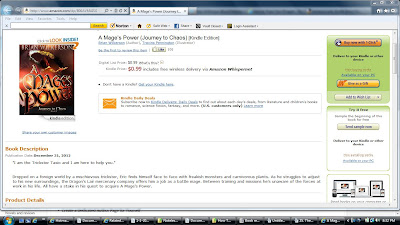
After seeing so many other books in this screen it's overwhelming to see my own in the same!
To think I believed I was done after five or so revisions.....I lost count but I think the final count is around ten. Apart from that I had to tell everyone about it but to do that I had to build the infrastructure to reach them; this blog for instance. Then I had to track down someone to make that amazing cover page you see before you. (Thanks again, Mr.Pennington!) I put out the word on Twitter and he followed me shortly afterward. In the time to come I'll commission him again to make the cover for the sequel, tentatively titled "Looming Shadow". The endless circle of writing continues!
Thursday, December 27, 2012
Editing; Professional Help or Not
When I set to revise my first novel, A Mage's Power, I resolved that I would do my own editing. I didn't want to pay hundreds of dollars for someone to do something that I could do myself. It made me feel lazy. Also, I didn't want to wait for them to get to and then finish my manuscript. Finally, I notice story elements that can be improved when I edit myself which is something an editor would not notice because they lack my background on the story. (See my post on "Useful Problems" for more information). As I do a third "Absolutely the Last Revision" I'm considering changing my policy for the sequel.
Time and again I am amazed by the errors I can miss. Double Double words; words in places the wrong; words that (are) missing, and words that the are unnecessary. It truly blows my mind when I find such errors in my manuscript and confirm that such errors exist in earlier copies of the same chapters. I don't know if it's my familiarity with the material that is the problem, my tendency to skip along so I can continue writing or both. It makes me want to pull my hair out.
After I publish A Mage's Power (it will published no latter than New Year's, by the way) I will begin revision work on the sequel, "Looming Shadow". Once I get the story where I want it I will likely find an editor to correct the errors listed above.
One thing is for sure: I will be aware of sticky keys, especially the 't'.
Subscribe to:
Posts (Atom)